Evidence scope: 2025 trade-show editorial signal
This review is dated 22 July 2026 and uses IFA Berlin's 2025 beauty-appliance editorial coverage as a directional signal. It is not a representative global survey and does not prove performance, safety or demand for a specific styler or attachment set.
Start with the styling job, not the attachment count
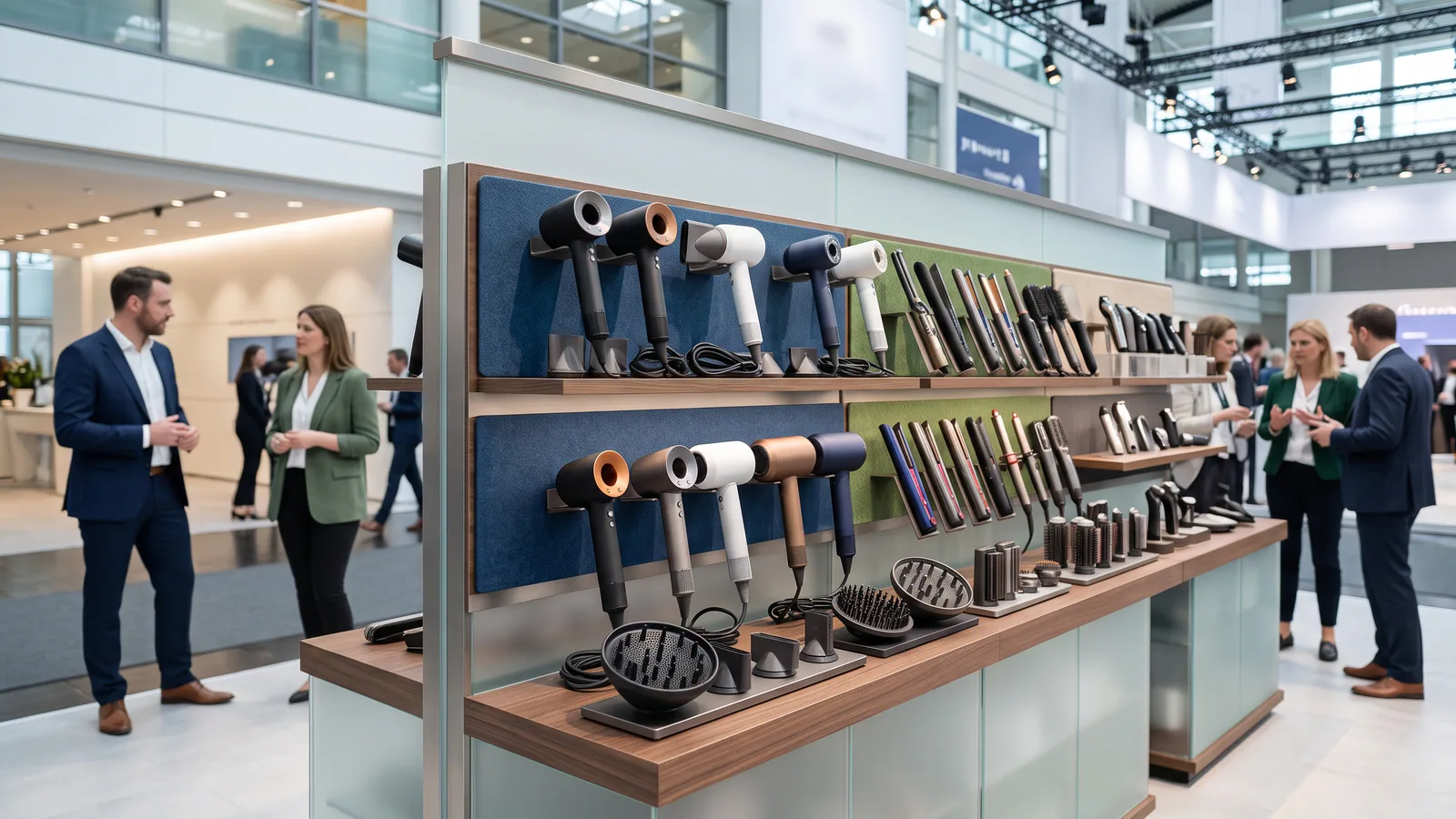
IFA’s 2025 editorial coverage shows multifunction and personalization as directional themes, not representative global demand. A buyer should begin with the styling job and target user.
Evaluate temperature selection, airflow, balance, grip, noise, cord reach and attachment handling over a complete task. More heat or more accessories does not by itself establish better performance. Claims about hair damage need appropriate evidence and market review.
The most common failure is equating more attachments or higher heat with better styling performance. Prevent it by separating facts already verified from proposals that still depend on the model, quantity, market or order. Keep the destination, electrical configuration and sales channel visible throughout the review; changing any of them can invalidate an earlier conclusion.
Evidence fields for a personal-care model
The working file should cover airflow and heat control, temperature levels, attachment interface, device weight, cord and storage, cleaning and replacement. Each record needs a version, owner and relationship to the offered model. If a file describes a component, prototype or related model, label that limitation rather than silently treating it as final-product evidence.
| Record | Evidence to examine | Decision signal |
|---|---|---|
| Dryer | Airflow, heat and weight | Drying task and comfort |
| Styler | Surface temperature and control | Hair-type use case |
| Attachment set | Retention and distinct function | User comprehension |
| Grooming tool | Blade or head maintenance | Cleaning and replacement |
| Storage | Cord, case and hot parts | Safe routine |
Test controls, ergonomics and attachments together
1. Name the styling job
Drying, smoothing, curling, volume and grooming require different airflow and contact.
2. Treat trend coverage as a signal
IFA editorial observations indicate directions, not representative global demand.
3. Test controls and ergonomics
Observe heat selection, grip, balance, noise, cord reach and repeated handling.
4. Challenge attachments
Check retention, orientation, hot removal, storage and whether users understand each piece.
5. Prepare support
Lint cleaning, damaged attachments, replacement parts and misuse questions need a plan.
Beauty-appliance claims that need careful evidence
For styling use cases, heat control and attachments, ask how each claim was produced and which model it describes. Descriptors such as standard, compliant, durable, quick or supported are conclusions until a method, configuration and record support them. Conflicting documents should be reconciled by model, revision, date and responsible issuer.
The offer boundary for styling use cases, heat control and attachments belongs in writing: exclusions, buyer-supplied inputs and changes that reopen cost, timing or validation. Private-label artwork can alter roles even when the base appliance is unchanged, so the review should identify the responsible entity rather than infer it from appearance.
Personal-care trial checklist
- Define target hair types and styles
- Test lowest and highest intended settings
- Measure comfort over a full task
- Inspect attachment locking and removal
- Review hot-surface handling
- Observe cleaning access
- Plan attachment replacement
- Avoid medical or damage-prevention claims without evidence
Ask trial users which attachment they chose, whether they understood it and how they stored or cleaned the set; usage evidence is more useful than feature count.
Example: an attachment set users cannot explain
A multi-attachment styler can create value when each attachment has a distinct, teachable result. If users cannot tell when or how to use the pieces, the set adds packaging and replacement burden rather than versatility.
Screening minMAX or COSONIC personal-care candidates
Review current minMAX or COSONIC personal-care models, then request the exact control, attachment, rating and support details. Trade-show trends cannot prove a brand offers a feature or that it suits every hair type.
Review current minMAX or COSONIC personal-care candidates on products, then request exact controls, attachments, rating and support details through the RFQ form.
Test communication as well as styling output
Personal-care products are often demonstrated through visual results, but buyers must also examine instructions, control labels and safe handling. Observe whether users can choose heat and airflow without coaching, attach and remove parts correctly, and identify surfaces that remain hot. Record hair type and task so outcomes are not generalized beyond the trial.
Merchandising claims should match the evidence and destination rules. Avoid medical language or absolute promises about damage prevention. If the product has several attachments, give each a distinct, supportable purpose in the sales material and confirm that replacements can be discussed for the model. Clear communication can reduce misuse and returns without inventing performance claims.
Sources and evidence
- Beyond the Mirror: 2025 Beauty Appliance Trends — IFA editorial coverage identifies multifunctional and personalized hair-care directions as a dated trade-show signal.
- IEC 60335-1:2020 — Household and similar electrical appliances fall under general safety requirements within the standard's scope.
Personal-care trend questions
Do more heat settings guarantee better control?
No. Usable temperature behavior, labeling and the user's task matter more than the count.
Are multifunction stylers replacing dryers?
They may overlap for some users, but channel and local use data should guide the assortment.
How should attachments be evaluated?
Test fit, retention, orientation, hot handling, storage, cleaning and distinct user benefit.
Can a product claim to prevent hair damage?
Such claims require appropriate, market-compliant evidence and careful wording; do not infer them from a feature.