Evidence scope: 2026 outlook, not a sales forecast
This review is dated 22 July 2026. Its market signal comes from NielsenIQ's published 2026 home-appliance outlook; the summary is broader than cooking appliances and does not establish demand in every country. Local retailer, search and sell-through evidence is still required.
Which cooking signal is worth a local test?
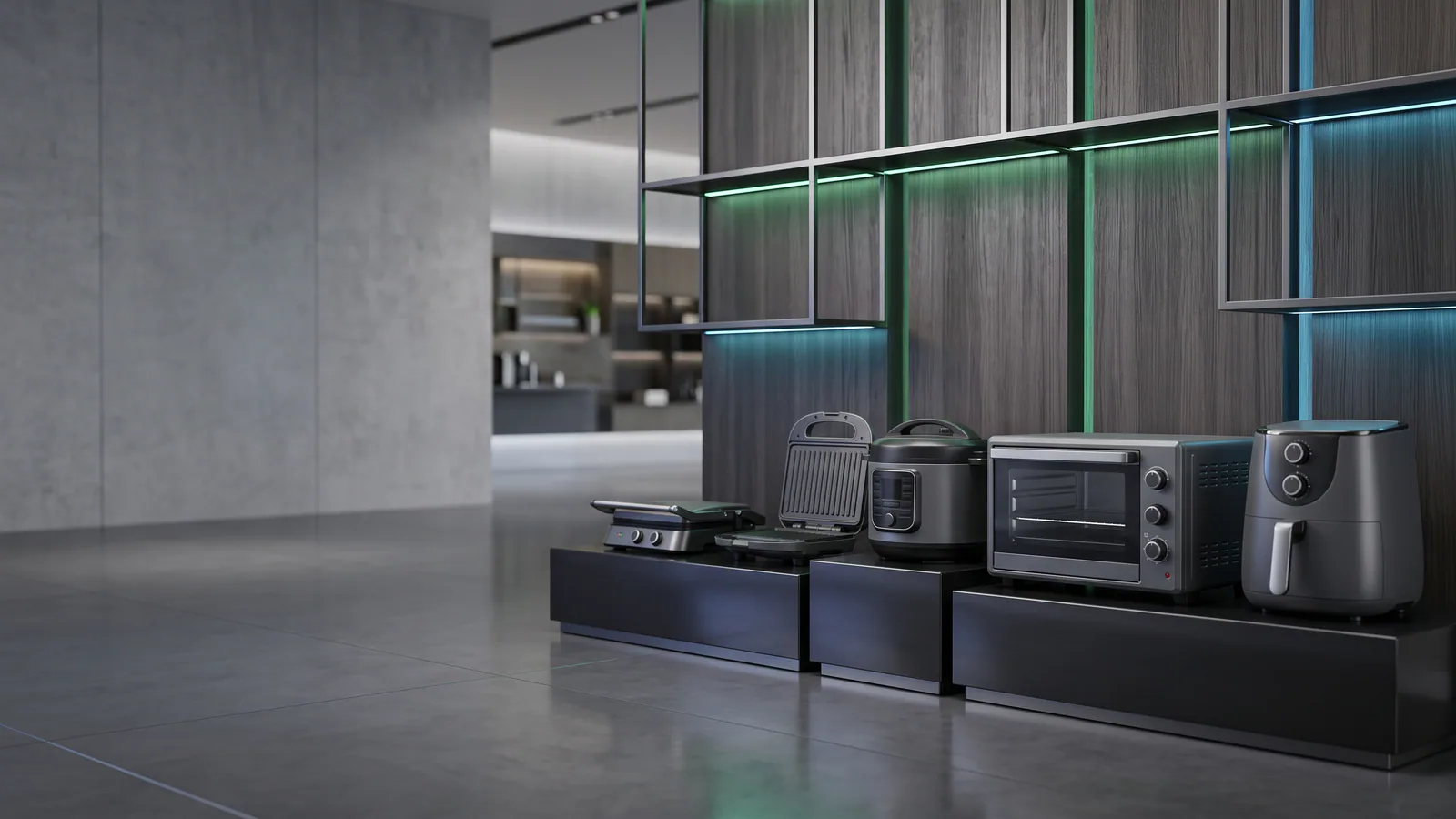
The 2026 outlook supplies hypotheses around convenience, quality, hygiene and value. A distributor still needs to decide which cooking mission and model execution justify a local trial.
Translate convenience into observed steps, versatility into functions people actually use and quality into repeatable sample results. Measure cleanup and support questions alongside cooking performance; a feature that sells the demonstration may still weaken ownership.
The most common failure is treating a broad industry outlook as proof that any air fryer, grill or multicooker will sell. Prevent it by separating facts already verified from proposals that still depend on the model, quantity, market or order. Keep the destination, electrical configuration and sales channel visible throughout the review; changing any of them can invalidate an earlier conclusion.
The product evidence behind a cooking trend
The working file should cover usable capacity, temperature control, cooking repeatability, cleaning access, counter footprint, service burden. Each record needs a version, owner and relationship to the offered model. If a file describes a component, prototype or related model, label that limitation rather than silently treating it as final-product evidence.
| Record | Evidence to examine | Decision signal |
|---|---|---|
| Convenience | Fewer steps or less attention | Observed task comparison |
| Quality | Control, fit, finish and repeatability | Sample protocol |
| Hygiene | Cleaning access and retained residue | Cleaning trial |
| Versatility | Useful functions, not menu count | Mission-based test |
| Value | Benefit relative to landed complexity | Channel review |
A five-stage cooking-appliance validation
1. Separate signal from product
Use industry research to frame questions, not to endorse a model.
2. Choose a cooking mission
Quick crisping, family batch cooking or compact versatility require different formats.
3. Test repeated results
Assess heat-up, control, capacity, loading and outcome under stated conditions.
4. Observe cleanup
Basket, cavity, grease, removable parts and coatings affect repeat use.
5. Pilot the proposition
Track demonstrations, customer questions, returns and reasons for nonpurchase.
Trend claims that should not enter an RFQ unchanged
For dated cooking-category signals and model trials, ask how each claim was produced and which model it describes. Descriptors such as standard, compliant, durable, quick or supported are conclusions until a method, configuration and record support them. Conflicting documents should be reconciled by model, revision, date and responsible issuer.
The offer boundary for dated cooking-category signals and model trials belongs in writing: exclusions, buyer-supplied inputs and changes that reopen cost, timing or validation. Private-label artwork can alter roles even when the base appliance is unchanged, so the review should identify the responsible entity rather than infer it from appearance.
Cooking-category trial checklist
- Date every trend source
- Define target household and meal mission
- Measure usable rather than nominal capacity
- Test presets against manual control
- Review hot surfaces and handling with qualified staff
- Time cleaning and drying
- Estimate return and support drivers
- Run a bounded market pilot
Write the pilot audience, channel, duration and success threshold before inventory arrives, then separate demand feedback from supplier nonconformity.
Example: presets that users never repeat
A model with many presets can look differentiated while producing little customer value if users rely on two manual settings. During trials, record which controls are understood and repeated rather than counting the menu labels.
Testing minMAX or COSONIC cooking candidates
Browse minMAX or COSONIC cooking categories for a current shortlist, then ask for sample, rating, capacity, accessories and cleaning information by model. The NIQ trend signal does not establish either brand's capabilities.
Shortlist current minMAX or COSONIC cooking models from products and request model evidence through the RFQ form; trend coverage proves no capability.
Measure the complete cooking ownership cycle
A category trial should begin before the first recipe and end after storage. Record setup, preheating, usable load, control changes, food handling, cool-down, grease management, washing, drying and counter or cupboard space. This reveals whether a convenience claim survives routine ownership rather than only the cooking demonstration.
Compare models on one or two target meals using controlled quantities and instructions. The exercise is commercial product evaluation, not a substitute for safety or laboratory testing. Ask participants which functions they would repeat without prompting and which accessories they understood. If a feature adds complexity but does not change the chosen cooking mission, it may be better treated as a secondary benefit than the reason to stock the model.
Sources and evidence
- Quality, Convenience, and Hygiene to Drive Growth in Home Appliances Market in 2026 — NIQ's 2026 outlook discusses quality, convenience, hygiene and value themes.
- General product compliance — Market-entry requirements depend on the product and destination and remain separate from trend demand.
2026 cooking-trend questions
Does current interest guarantee air-fryer category growth?
No category is guaranteed. Local penetration, channel competition and model execution must be measured.
Is a larger basket always better?
No. Usable capacity, footprint, power, household size and cooking pattern must align.
How should cleaning be evaluated?
Run the full cool-down, disassembly, washing, drying and reassembly workflow.
Does multifunction reduce assortment size?
Only if the functions are credible, understandable and supported without unacceptable compromise.