Build the assortment around customer missions
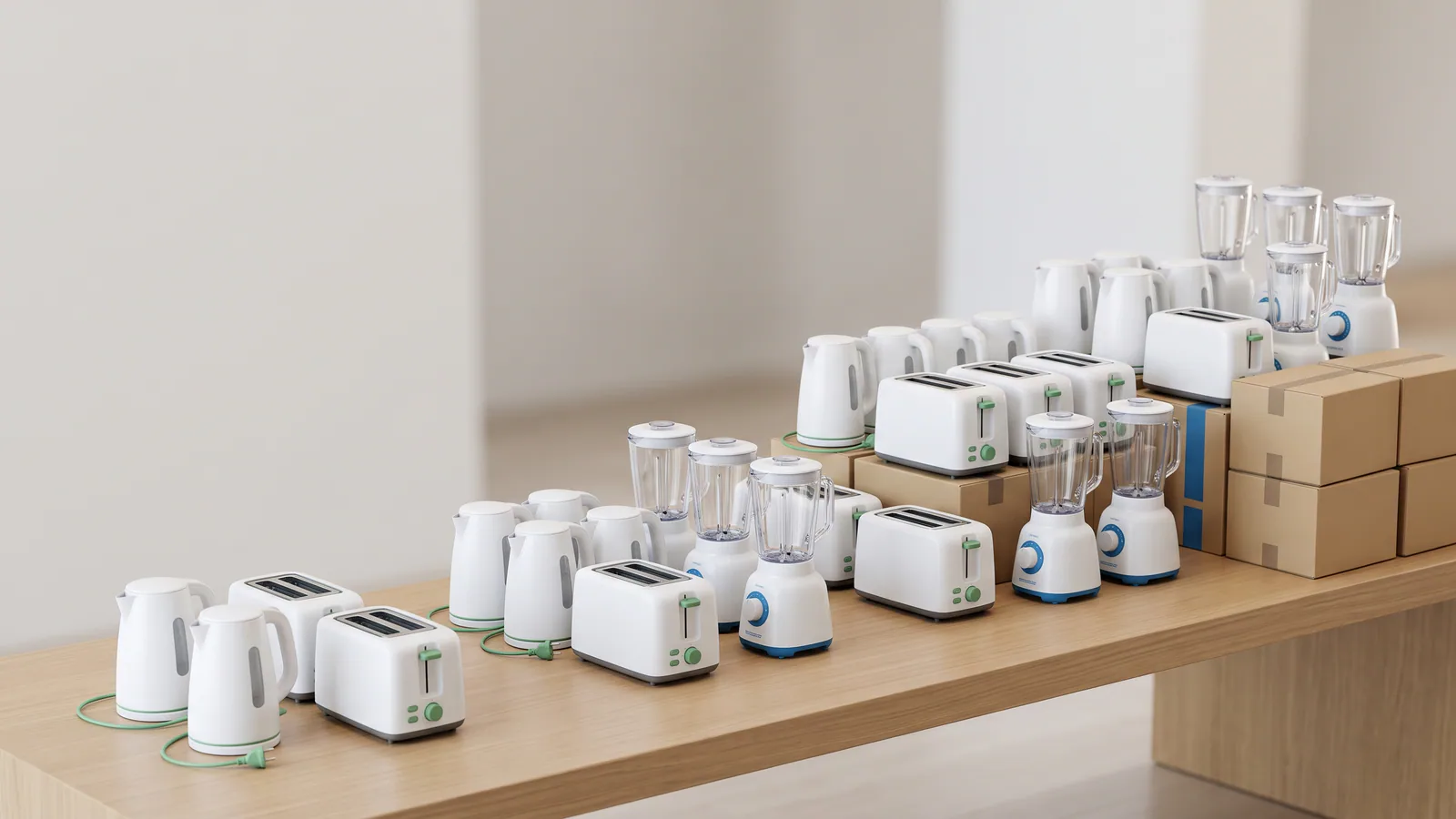
A coordinated range gives each model a distinct customer and channel role. It is not simply a collection of matching colors or the largest possible catalog.
Use entry, core, hero, step-up and attachment roles only where buyers can explain the difference. Range economics should include inventory concentration, packaging, training, spare parts and returns. Remove candidates that duplicate a job without adding measurable value.
The most common failure is collecting visually attractive products without a shopper mission, price ladder or replenishment logic. Prevent it by separating facts already verified from proposals that still depend on the model, quantity, market or order. Keep the destination, electrical configuration and sales channel visible throughout the review; changing any of them can invalidate an earlier conclusion.
The roles that prevent SKU duplication
The working file should cover customer mission, entry model, hero model, step-up benefit, attachment product, service load. Each record needs a version, owner and relationship to the offered model. If a file describes a component, prototype or related model, label that limitation rather than silently treating it as final-product evidence.
| Record | Evidence to examine | Decision signal |
|---|---|---|
| Entry | Accessible route into category | Simple, understandable benefit |
| Traffic | Matches common search or channel demand | Competitive core specification |
| Hero | Explains the category story | Demonstrable difference |
| Step-up | Meaningful capacity or function gain | Justified complexity |
| Attachment | Complements another purchase | Low support friction |
From shopper need to category architecture
1. Choose the missions
Group needs such as quick cooking, breakfast routine, cleaning or personal care before choosing SKUs.
2. Assign model roles
Define entry, traffic, hero, step-up and attachment jobs in plain language.
3. Build meaningful steps
Capacity, function or ownership benefits should change clearly between adjacent models.
4. Balance operations
Consider carton sizes, electrical variants, spare parts, training and forecast concentration.
5. Set review rules
Measure inquiries, sell-through, returns, support and substitution; remove products without a clear role.
Assortment ideas that need commercial proof
For customer missions and distinct model roles, ask how each claim was produced and which model it describes. Descriptors such as standard, compliant, durable, quick or supported are conclusions until a method, configuration and record support them. Conflicting documents should be reconciled by model, revision, date and responsible issuer.
The offer boundary for customer missions and distinct model roles belongs in writing: exclusions, buyer-supplied inputs and changes that reopen cost, timing or validation. Private-label artwork can alter roles even when the base appliance is unchanged, so the review should identify the responsible entity rather than infer it from appearance.
Range-planning checklist
- Name one primary customer job per model
- Avoid adjacent near-duplicates
- Create a visible capacity or function ladder
- Limit unmanageable color variants
- Estimate support burden
- Plan cross-category visual consistency
- Define trial success metrics
- Set replacement and exit criteria
Record a success measure and exit rule for each trial model, so replenishment follows evidence rather than catalog inertia.
Example: three near-identical air fryers
Three air fryers differing only slightly in capacity may fragment stock without expanding demand. A stronger architecture might use a compact entry model, a clearly larger family model and a distinct multifunction format—provided each passes market and service validation.
Reviewing minMAX and COSONIC as one candidate pool
The minMAX and COSONIC catalog can be reviewed as one source of category candidates, while each brand retains its own positioning. Buyers should send the desired category roles and market constraints; current models and commercial fit require confirmation.
Use minMAX and COSONIC product categories as a candidate pool, then send category roles and quantities through the dealer inquiry.
Review portfolio performance as a system
Measure more than sell-in. Track model-level inquiries, conversion, replenishment, returns, support contacts and reasons for substitution, then examine how products affect one another. A hero product may generate category interest while an entry model closes more sales; both can have valid roles if the economics are understood.
Hold a scheduled range review with sales, inventory and service teams. Decide which models to replenish, reposition, replace or retire. When adding a candidate, state which role it fills and whether it increases color, plug, packaging or spare-part complexity. This prevents assortment growth from becoming automatic. A coordinated range remains coherent because additions and removals follow explicit customer and operating evidence.
Sources and evidence
- Quality, Convenience, and Hygiene to Drive Growth in Home Appliances Market in 2026 — NIQ identifies quality, convenience, hygiene and value as current home-appliance themes.
- [PRODUCT.md](internal://PRODUCT.md) — The site is designed for B2B range discovery, product comparison and qualified RFQ rather than retail checkout.
Assortment-planning questions
How many hero models should a category have?
Usually few enough that sales teams can explain the distinction; the right number depends on channel breadth.
Should all appliances share one color?
Visual coordination can help, but forcing colors may raise MOQ or hide more important product differences.
What is an attachment product?
A product that complements another mission or purchase, not merely an extra SKU.
When should a model be removed?
When it lacks a distinct role, evidence of demand or sustainable support economics after a defined review.